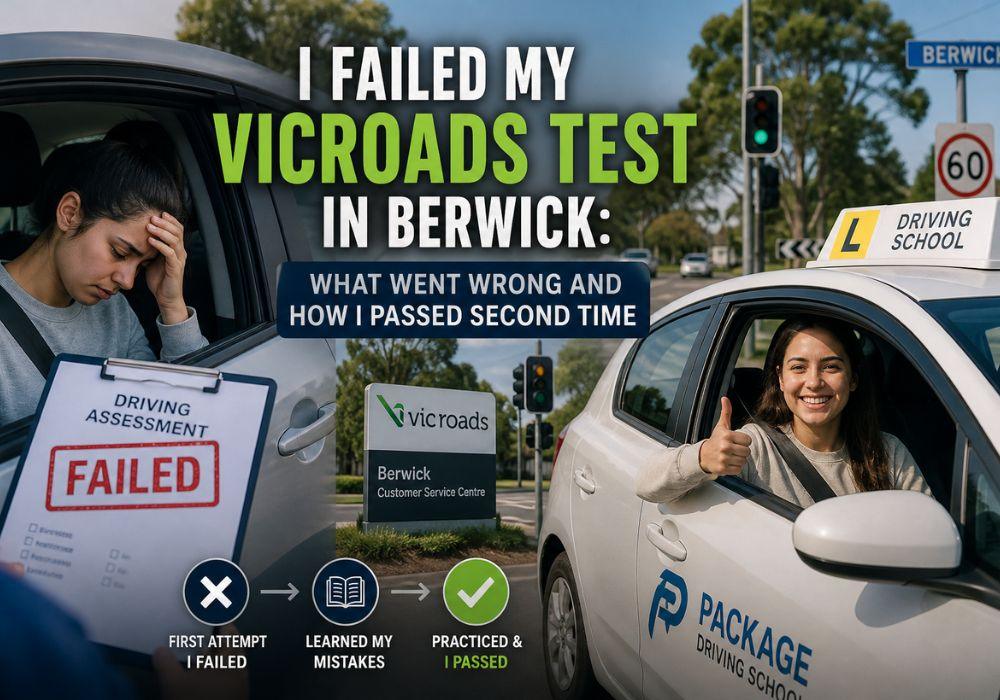
I still remember the sinking feeling as the VicRoads examiner in Berwick shook his head and marked my driving test as a fail. After months of practice and countless hours behind the wheel, I made critical mistakes under pressure.
I was disappointed. But determined. I analysed every error, adjusted my approach, and returned for the second attempt.
In my second attempt, I passed with confidence. Here is the matter: feeling ready and being test-ready are two very different things.
In this story, I share exactly what went wrong on my first VicRoads test in Berwick and the practical changes that helped me succeed on my second try.
What the Berwick Test Route Actually Throws at You
Most learners go in blind about the actual roads, and that's a real disadvantage in Berwick specifically. If you've been doing your
driving lessons in Berwick on quiet backstreets, the test route will feel like a different world entirely.
The testing area covers Clyde Road, stretches of the Princes Highway, and residential streets around Harkaway and Narre Warren. High-speed merging on the Princes Highway at 80 km/h, lane changes, and busy roundabouts are common features. Hesitation or poor signalling at these points is a frequent fail.
Areas like Narre Warren and Berwick have heavier traffic and more complex roads than many other Melbourne test zones. That complexity matters when you're already trying to manage nerves, watch your speed, and keep up your mirror checks simultaneously.
Speed zone transitions are a particular trap in the area. The Princes Highway drops from 80 to 60 km/h, and it happens fast. If you're not watching the signs and monitoring your speedo at the same time, you'll drift over without realising.
The Three Things That Actually Failed Me and Tips to Overcome
Looking back, it wasn't one big dramatic mistake. It was three smaller habits I'd let get sloppy during practice.
- Rolling Through Give Way Signs
I treated give way signs as "slow right down and check," which is actually correct for give way situations. But where I got caught was at stop signs. At a stop sign, your vehicle must come to a complete standstill with no forward rolling before you proceed. My foot wasn't fully stopping the car, and the examiner noted it twice. These are two different signs with two different rules, and mixing them up during a test can cost you dearly.
Give way tip for learners
| At every stop sign during practice, make yourself come to a complete standstill, even when no traffic is anywhere near you. You're not just trying to remember a rule. You're rewiring what feels normal behind the wheel. Do it until it's automatic. |
- Mirror Checks That Weren't Visible Enough
VicRoads examiners watch for continuous scanning, mirror checks, and proper head checks during merging, turning, and reversing. I was doing signal-then-move, skipping the head check.
Tip for learners about mirror checking
| Think of observations as something you do for your own safety, not to perform for the examiner. When the mindset shifts that way, the checks become more natural and more deliberate at the same time. |
- Speed Creep on the Highway Section
On the Princes Highway section, I drifted to 67 km/h in a 60 zone without noticing. In the VicRoads test, even a brief exceedance of the posted speed limit is an Immediate Termination Error. In school zones, any amount over the limit, even for a moment, is an instant fail.
A tip about the speed
| Glance at your speedo every 5 to 10 seconds, especially when entering new streets or after roundabouts. Set a rhythm for it during practice so it becomes part of how you drive, not something you have to consciously remember during the test. |
The Mistake Most People Don't Talk About: Driving Too Slowly
In Victoria, examiners specifically watch whether you reach the posted speed within a reasonable distance after turning onto a new road. Crawling at 40 in a 60 zone with no reason will cost you marks.
So many learners are so scared of speeding that they creep well under the limit instead, which the examiner reads as poor confidence or a lack of road awareness. Either extreme, too fast or too slow, can cost you the test.
Tip for learners
| When you turn onto a new street, actively look for speed signs straight away. If you can't spot one, check the left side for repeater signs. In residential areas without signs, the default speed limit in Victoria is 50 km/h. |
What I Did Differently Before the Second Attempt
I didn't just book more lessons and hope for the best. I was specific about what needed fixing.
Drove the Berwick Test Roads Deliberately
I found which roads the test typically covers through local learner groups, then practised those exact stretches with my supervisor. Not nearby roads, those roads. Knowing where the 60 km/h zone starts on Clyde Road before you hit it during a test is a completely different experience from discovering it live.
If you're preparing for your test, our
Berwick driving test preparation guide covers the specific routes and common trouble spots in detail.
Booked with an Instructor Who Knew the Berwick Area
Not just a driving school with good reviews, but also an instructor who regularly prepares students for the Berwick VicRoads test specifically. They know which intersections examiners focus on and the rhythm of that particular route. Ask them directly whether they know the Berwick test area before you book.
Reprogrammed the Habit, Not Just the Knowledge
At every give-way sign during practice drives, I made myself come to a full, complete stop. I wasn't just trying to remember a rule. I was rewiring what felt normal.
A real-life tip for learners
| Ask your supervising driver to stay quiet during practice runs and give directions late, the way an examiner would. The silence in the car during a real test can be genuinely unsettling if you've never experienced it. |
The Scoring System Is a Must to Know
Victoria uses a two-tier error system, and most learners only half understand it.
- Critical Errors carry demerit points, and accumulating too many across the test will result in a fail.
- Immediate Termination Errors are different; one of those ends your test on the spot, no matter how well the rest of the drive has gone.
The Immediate Termination Errors include examiner intervention, disobeying a direction, a collision, failing to give way, exceeding the speed limit, failing to stop at a red light or stop sign, and other actions judged to be immediately dangerous.
Check the current VicRoads list directly before your test, as details can be updated.
Read it again a week before your test, with fresh eyes and actual road experience behind you. It lands the second time differently.
A Practical Note on Rebooking
After failing, you need to wait at least seven days before booking your next VicRoads test. Retest slots can be competitive, so book early and check for last-minute cancellations.
Use that week properly. The score sheet the examiner hands you is the most valuable thing to come out of a failed test. It tells you exactly what the problem was. If you put it in a drawer and just drive more hours without addressing those specific points, you're likely to repeat the same result.
Some learners wonder if intensive driving lessons might help after a failure. While you can't usually get your license in a week, condensed lessons focused on your specific weak points can be valuable.
For the most current road rules and test requirements, visit the official Victorian Government transport website at
transport.vic.gov.au.
The VicRoads
Drive Safe Handbook is also worth reading to cover before your test, and it's free to download from the same site.
Read more: Driving Around Casey Hospital & Chisholm TAFE: A Berwick Learner's Local Hazard Guide