
Most Werribee learners think they are ready. Roughly 1 in 4 still fail their first attempt. The difference is rarely skill. It is preparation.
This blog covers what the test actually checks, where people go wrong at this specific centre, and what to fix before you book.
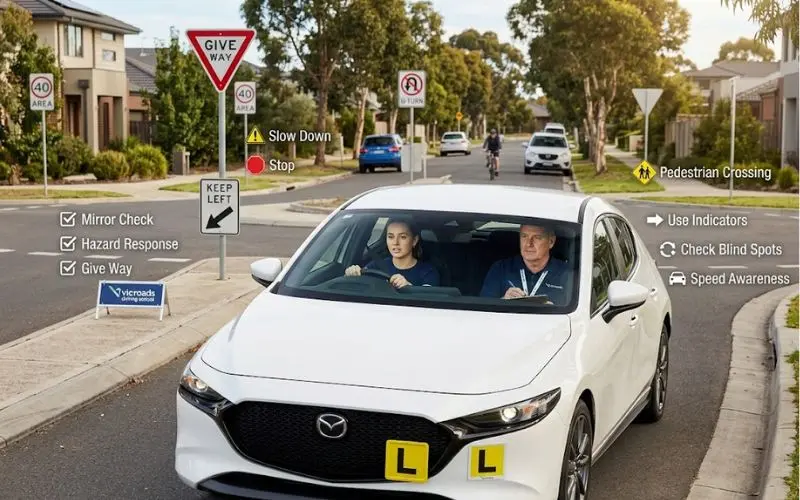
1. The Werribee Pass Rate Is Lower Than You'd Expect
Werribee sits at around a 75% pass rate, which means roughly 1 in 4 learners fail their first attempt at this specific centre. That's not meant to scare you. It means going in underprepared is a real risk, even if you feel confident.
The test runs for about 30 to 40 minutes. It starts with a pre-drive check, then takes you through suburban streets, some busier roads, and back. The assessor is marking you the entire time.
We recommend:
Do at least one or two practice drives starting from Synnot Street itself. If you have not already, booking a few driving lessons in Werribee with a local instructor who knows the test routes is one of the most practical things you can do.
Getting familiar with that specific exit, the surrounding streets, and the early part of the route takes a lot of pressure off the first few minutes.
2. Your Car Can Fail You Before You've Even Moved
Vehicles with an electronic park brake cannot be used in the VicRoads drive test, and the assessor must be able to see the entire speedometer from the passenger seat. If your car has either of those issues and you show up anyway, the test is cancelled. You still pay.
An unroadworthy vehicle is an immediate fail. Check your lights, wipers, tyres, and washer fluid the day before, not the morning of.
We recommend:
If you're using your own car, go through the full pre-drive check at home first: low beams, high beams, brake lights, tail lights, wipers, and tyre condition. Do it out loud, the way you would in front of an assessor. It feels unnecessary until the moment it isn't.
3. The First 300 Metres Are Where Nerves Do the Most Damage
One of the most common scenarios: a learner who has genuinely prepared well, drives well during lessons, and then makes a basic error almost immediately on test day. Missed stop signs close to the start. Forgetting to check mirrors before pulling out. Even starting to move before the engine is properly on.
VicRoads data shows that around three-quarters of failed drive tests are due to immediate termination errors, which are the types of errors most likely to cause serious accidents on real roads.
These aren't random failures. They happen because nerves compress your attention onto one thing at a time. If anxiety behind the wheel is something you struggle with, nervous driver lessons in Werribee are specifically designed to help anxious learners build confidence before test day.
We recommend:
Treat the first few minutes of the test exactly like the rest of it. Don't tell yourself "just get settled first." Stay in your routine from the second the assessor says go.
4. The Derrimut Road Turn Catches People Off Guard
The Werribee test route regularly takes you through a turn from Princes Highway into Derrimut Road. You may be directed to turn left from the right lane, a counter-intuitive move that catches people off guard if they haven't practised it.
The roundabouts near Werribee Plaza on Heaths Road are another known trouble spot. Give way rules, correct lane discipline, and signalling when exiting all apply here, and all three are being assessed simultaneously.
We recommend:
Drive the actual roads near the Synnot Street centre, not just roads that feel similar. The specific instructions and intersections on a Werribee test route are different from what you will get anywhere else, and familiarity with them before test day is a genuine advantage. See the Werribee VicRoads test route mapped out with tips from learners who passed.
5. School Zones Are Not Optional at Certain Times
There are multiple school zones along common Werribee test routes. In Victoria, the speed limit drops to 40 km/h in school zones between 8:00 and 9:30 am and 2:30 pm to 4:00 pm on school days.
Missing the zone sign or not dropping speed quickly enough is a serious mark against you. Some tests are scheduled right in the middle of the school morning rush, which means the zone is active and traffic around it is heavier than normal.
We recommend:
Book your test at a time when you can be alert and focused. An early morning test during peak school drop-off has more variables than a mid-morning slot. Know in advance whether your test time overlaps with school zone hours, so you're not caught off guard.
6. Being Too Slow Is a Real Fail Risk
A lot of learners go into the test thinking "slow and careful" is the safest approach. Driving significantly under the speed limit without a reason is assessed as poor road behaviour, not caution. Sitting at 42 km/h in a 60 zone with clear conditions, for an extended stretch, signals that you can't read the road.
The assessor wants to see confident, appropriate decisions. That includes keeping up with the flow of traffic when conditions allow it.
We recommend:
On open suburban roads with good visibility and no hazards ahead, drive close to the posted limit. If you're consistently sitting 15 to 20 km/h under it out of nerves, practise building that up before test day.
7. Observation Checks Have to Be Visible
In Victoria, head checks are a marked assessment item. You need to do a real, physical head turn before changing lanes, merging, or moving off from a stopped position. If an assessor can't see that you looked, a critical error for failing to look is recorded.
A slight eye movement doesn't count. The assessor is watching for the turn of your head.
We recommend: During practice, make your head checks obvious enough that someone sitting next to you could clearly see them. If you're not sure whether your checks are visible enough, they probably aren't. Make it a habit before test day, not something you try to remember to do on the day.
8. Log Book Issues Can Cancel Your Test on the Spot
If you are using a paper log book, make sure all entries are complete, and your supervising driver has signed both sections at the front. Incomplete or incorrectly filled log books are a more common cancellation reason than people expect.
If you are under 21, you need 120 hours, including at least 20 hours of night driving. Those hours need to be recorded accurately, whether you are using a paper log book or the myLearners app.
Our full guide to completing your 120-hour logbook in Werribee without the stress walks you through exactly how to track and record your hours correctly.
We recommend:
Check your logbook a full week before your test, not the night before. If something is missing or a signature is incomplete, you need time to sort it out. VicRoads won't make exceptions on the day.
9. You Can Request a Different Examiner Before the Test Starts
Some learners have reported being able to politely request a different examiner before the test begins, though this is not a formally documented VicRoads policy. If something feels off, speaking to centre staff calmly before you get in the car is always worth considering.
Assessors at Werribee vary in communication style. Some candidates find certain examiners calmer and clearer with instructions. If something feels off before you even pull out, it's better to say something quietly than to spend 30 minutes tense and distracted.
We recommend:
Arrive 20 to 30 minutes early. Get your paperwork sorted, settle into the space, and give yourself a moment to assess how you're feeling. Walking in relaxed and familiar with the environment is half the battle.
10. Failing Without Using the Feedback Is the Biggest Waste
If you fail, the assessor tells you what went wrong. They're required to. That feedback is specific: which category of error, how many times it occurred, and whether it was a critical or immediate termination error.
A lot of learners rebook quickly, practise generally, and make the same mistakes again. For learners who fail due to a termination error, the failure often highlights that they don't yet have the experience needed to drive safely without supervision, which means the work to do is targeted, not vague.
We recommend:
After a fail, write down exactly what the assessor said. Don't interpret it. Don't minimise it. Take that specific information into your next practice sessions and work on those exact things. Rebooking without changing anything is just paying the $73.30 fee again for the same result.
The total cost of a Werribee VicRoads drive test is $73.30, $51.80 for the test plus a $21.50 appointment fee. That's per attempt. The money is the least of it. The time, the nerves, and the delay to your licence are what add up.
Prepare for the specific roads, the specific rules, and the specific things that get people to this centre. That's what makes the difference.
Note: Test fees, logbook hours, and licence requirements are subject to change. Visit VicRoads for the most current information before booking your drive test.
READ MORE: Automatic vs Manual Driving Lessons in Officer: Which is Better?
Frequently Asked Questions
Can I cancel or reschedule my Werribee drive test without losing my fee?
Yes, but you need to do it at least two full business days before your appointment. Cancel with less notice than that, and VicRoads keeps the $21.50 appointment fee, regardless of the reason.
What if I don't hear or understand an instruction from the assessor during the test?
You can ask them to repeat it. Assessors expect this to happen occasionally, and asking clearly is far better than guessing and turning the wrong way. Just say "sorry, could you repeat that?" and continue normally.
Do I still need 120 hours if I'm 21 or older when I go for my licence?
No. In Victoria, the 120-hour logbook requirement only applies if you are under 21 when you sit for your probationary licence. If you are 21 or older, there is no minimum hour requirement, though you still need to hold your learner permit for a minimum period of 6 months if you are between 21 and 25, and 3 months if you are 25 or over. VicRoads still strongly recommends extensive practice before your test, regardless of age.