
Night Driving Practice Tips for Learners in Frankston
Under Victoria’s Graduated Licensing System, learners under 21 must log at least 20 hours of night driving within their 120 supervised hours before sitting the VicRoads drive test. Hours are tracked through the myLearners app, VicRoads’ official logbook tool.
The TAC has confirmed that first-year P-plate drivers are seven times more likely to be killed or seriously injured between 10 pm and 6 am than fully licensed drivers.
On average, around 31 first-year P-platers are killed or seriously injured driving at night in Victoria every year.
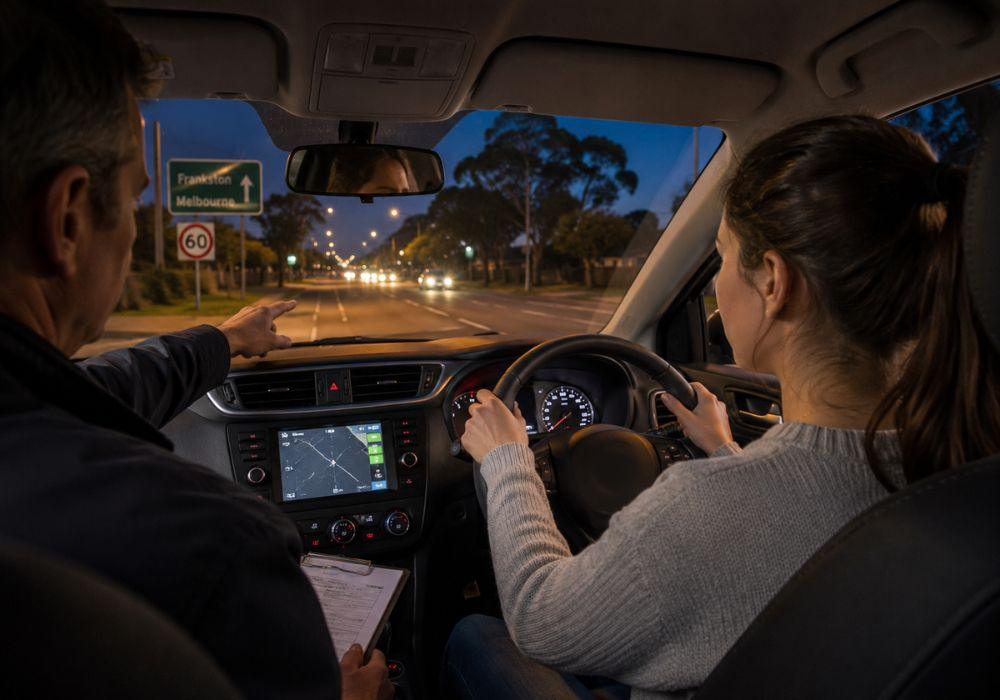
The Real Problems Learners Run Into
Headlight Glare on Nepean Highway
This is the most common concern we hear. Learners comfortable in daylight suddenly struggle with oncoming high beams on multi-lane sections of Nepean Highway through Frankston South and the township.
The instinct is to stare at the lights or drift away from them. Both responses are wrong.
When oncoming headlights hit you, shift your gaze to the left edge of your lane and use the road marking to hold your position. Do not look into the glare. Before you leave, dim your dashboard display too. Bright cabin lighting creates a windscreen reflection that quietly cuts your visibility more than most learners realise.
Not Knowing When High Beams Apply
Learners either avoid high beams entirely or forget to drop back to low beams when another car appears. On darker stretches toward Langwarrin or Baxter, high beams are genuinely useful. But leaving them on for oncoming traffic is dangerous and against road rules.
High beams are for unlit roads with no oncoming traffic or vehicles ahead of you. The moment you see headlights or taillights, drop back immediately. We recommend building this as a deliberate habit from your first night session, not something you work out later on your Ps.
Wildlife on Roads South of Frankston
This is something many learners do not think about until it is too late. Wildlife Victoria has reported that vehicle collision cases on the Mornington Peninsula have risen by approximately 135% in the last five years, with kangaroos being the species most commonly struck.
Any night run down Frankston-Flinders Road toward Baxter, or past Mount Eliza on Nepean Highway, puts you in wildlife territory from dusk onward.
Our tip: Kangaroos move in groups. If you see one on the road edge, slow down and assume there are more nearby. Do not swerve. Brake firmly and hold your lane. Swerving to avoid an animal is one of the most common causes of serious single-vehicle crashes on peninsula roads at night. |
Where to Build Night Driving Skills in Frankston
Start in Frankston North and the Seaford suburbs. These areas have 50 km/h limits, reasonable street lighting, and low traffic after 8 pm. Focus on reading lane markings, watching for pedestrians near driveways, and adjusting to gaps between street lights.
Move to Nepean Highway after a few sessions. It is well-lit through the Frankston township, features multi-lane traffic, and is part of the actual VicRoads drive test route. Practise lane changes, merging, and speed management while dealing with oncoming glare.
Add darker roads once you are comfortable. Runs toward Langwarrin or Baxter along Frankston-Flinders Road introduce limited lighting, real wildlife conditions, and the kind of roads you will face unsupervised once you get your Ps.
Stage | Location | Focus |
Sessions 1-5 | Frankston North, Seaford | Lane keeping, sign reading, pedestrian awareness |
Sessions 6-12 | Nepean Highway, Frankston CBD | Glare, merging, speed consistency |
Sessions 13-20 | Langwarrin, Baxter direction | Wildlife, low-light hazards, wet conditions |
Practical Habits That Change How You Drive
Extend your following distance. The two-second rule in daylight becomes at least three seconds at night, and more in wet conditions. Reaction time slows, brake lights are harder to read in rain, and depth perception is reduced.
Match speed to your headlights. Low beams illuminate roughly 40 to 60 metres ahead. At 60 km/h, stopping distance in dry conditions is around 45 metres. On unlit roads past Frankston, many learners are travelling faster than their headlights allow them to react safely. Tailored Frankston driving lessons can help you practise judging speed and stopping distance on these roads before you tackle them alone.
Log every session immediately. The myLearners app allows supervisors to approve drives through the app or their myVicRoads account, but don’t rely on doing it days later. Record the drive straight after finishing and have your supervisor confirm it the same night.
Our tip: Missing supervisor signatures from earlier night sessions are one of the most common reasons VicRoads cancels drive test bookings on the actual day. Do not let a simple logbook gap cost you your test fee and appointment. |
The night driving hours you log now in Frankston are the same conditions that catch new P-platers off guard every year. Practise them properly while you still have someone beside you.
DRIVING TEST & DRIVING LESSON PACKAGES
PLANS & PRICING
Great last minute appointment.
Great last minute appointment. Would definitely recommend for a driving instructor!  Great advice and a very nice humble person.

TONY SPAULL
Learnt a lot of new things that helped me during my driving test.
I had an amazing experience with my driving instructor. Learnt a lot of new things that helped me during my driving test. Very thankful

UROOBA MALIK
Great instructor.
Great instructor. Very friendly. I would highly recommend this one.
